
Elevating Secondary Instruction through Bloom’s Taxonomy

Just What is Bloom’s Taxonomy?
Bloom’s Taxonomy is a way to organize different types of learning and thinking skills, from the simplest to the most complex. The original version, proposed by Benjamin Bloom in 1956, consists of six main levels.
Like six! It’s a lot to remember as a teacher, but let’s try to break it down, and read till the end for a treat. Here’s what these levels are:
KNOWLEDGE
The Knowledge level is where we flex our memory muscles and channel our inner trivia masters. Picture yourself as a walking encyclopedia, armed with the ability to recall all the random facts and data you’ve ever stumbled upon. It’s like being a human search engine, but without the need for understanding – just raw, unadulterated recall. This level sets the stage for some seriously deep learning and brain acrobatics, so make sure to give your memory the appreciation it deserves!
Key Characteristics:
Recall: Simply bringing information to mind. For example, recalling the capital of a country or the date of a historical event.
Recognition: Identifying correct information from a list of options. For instance, recognizing the correct definition of a term from multiple choices.
Listing: Enumerating items or facts in a sequence, such as listing the steps in a scientific process.
COMPREHENSION
The Comprehension level in Bloom’s Taxonomy is like the “Aha” moment of education, where you not only recall information but also understand and grasp its meaning. It’s all about interpreting, explaining, comparing, contrasting, and predicting ideas – kind of like being a mind-reading wizard. This level is basically about making sense of the material and being able to express it in your own hilarious words.
Key Characteristics:
Translation: Converting information from one form to another, such as paraphrasing or summarizing like summarizing a paragraph in your own words.
Interpretation: Explaining or clarifying the meaning of information. For Example: Explaining the significance of a graph or data set.
Extrapolation: Predicting or inferring based on given information like predicting what might happen next in a story based on the current events.
APPLICATION
The Application level in Bloom’s Taxonomy is where our little learners take their understanding of concepts and information and apply them to new situations or contexts. It goes beyond comprehension and involves using learned knowledge and principles in practical ways. This level focuses on using knowledge and skills to solve problems, complete tasks, and address challenges in real-world scenarios.
Execution: Applying learned procedures or methods to solve problems. For example, in math, using a mathematical formula to solve a real-world engineering problem.
Implementation: Using strategies or techniques learned in one context in a different context. In an English class, applying grammar rules learned in English class to write a persuasive essay.
Performance: Demonstrating skills or knowledge in a practical setting. If you teach a class that students must physically perform like a music, then performing a piece of music on an instrument after learning the notes and rhythm is how we’d make it work in this class.

ANALYSIS
The Analysis level of Bloom’s is where we put on our detective hats and embark on a quest to uncover the juicy secrets of information. It’s like taking a magnifying glass to data, Sherlock style, and figuring out how all the little pieces of the puzzle fit together. So, prepare to compare, contrast, and organize like a champ as we unravel the hidden structure and significance of the information!
Key Characteristics:
Examination: Breaking down information into its components to understand their relationships. This is where breaking down a complex historical event into its causes and effects, for example.
Differentiation: Distinguishing between different parts or aspects of information. This is one of our most used Analysis trait. History classes and English classes tend to emphasize differentiating between primary and secondary sources in research.
Identification of Patterns: Recognizing patterns or trends within data or information. For example, students will identify recurring themes in literature or historical events.
SYNTHESIS
The Synthesis stage is where learners get to put on their creativity hats and whip up something zesty. It’s all about taking knowledge and mixing it up like a crazy chef, throwing in some problem-solving skills and a pinch of innovation to cook up a whole new dish. So, get ready to shake up the educational kitchen and serve some fresh, out-of-the-box ideas!
Key Characteristics:
Creation: Developing original ideas, solutions, or products by combining existing elements. For example, students may have to design a new invention based on scientific principles learned.
Design: Formulating plans or blueprints for structures, systems, processes, or products. Designing a sustainable city layout based on environmental principles for example will be a dynamic way for students to bring ideas together.
Invention: Generating new methods, theories, or approaches that integrate existing knowledge. This trait depicts inventing a new algorithm for solving complex mathematical problems, for example.
EVALUATION
The Evaluation level in Bloom’s Taxonomy is the highest cognitive level where learners critically assess information, ideas, methods, or products to determine their value, effectiveness, or significance. It involves making judgments based on criteria and standards, and it requires learners to defend their opinions with reasoned arguments. Evaluation goes beyond understanding, applying, and analyzing information—it focuses on synthesizing information and making informed judgments.
Key Characteristics:
Judgment: Making informed and reasoned decisions about the quality or value of something. For example, evaluating the effectiveness of a government policy in addressing social inequality would work.
Critique: Providing insightful feedback or criticism based on established criteria. Critiquing the strengths and weaknesses of a scientific study based on its methodology and findings is a great example.
Assessment: Assessing the relevance, reliability, and credibility of information or sources. Assessing the accuracy of historical accounts based on multiple sources and perspectives or evaluating the outcome of thoughtful analyses.
In the end, these are some of the traits of the elements of Bloom’s Taxonomy. These are ways to make certain you get your students to think critically and creatively. The thing is there is so much more to cover in Bloom’s. I believe I have composed a lot more in the resource below.
Check it out!
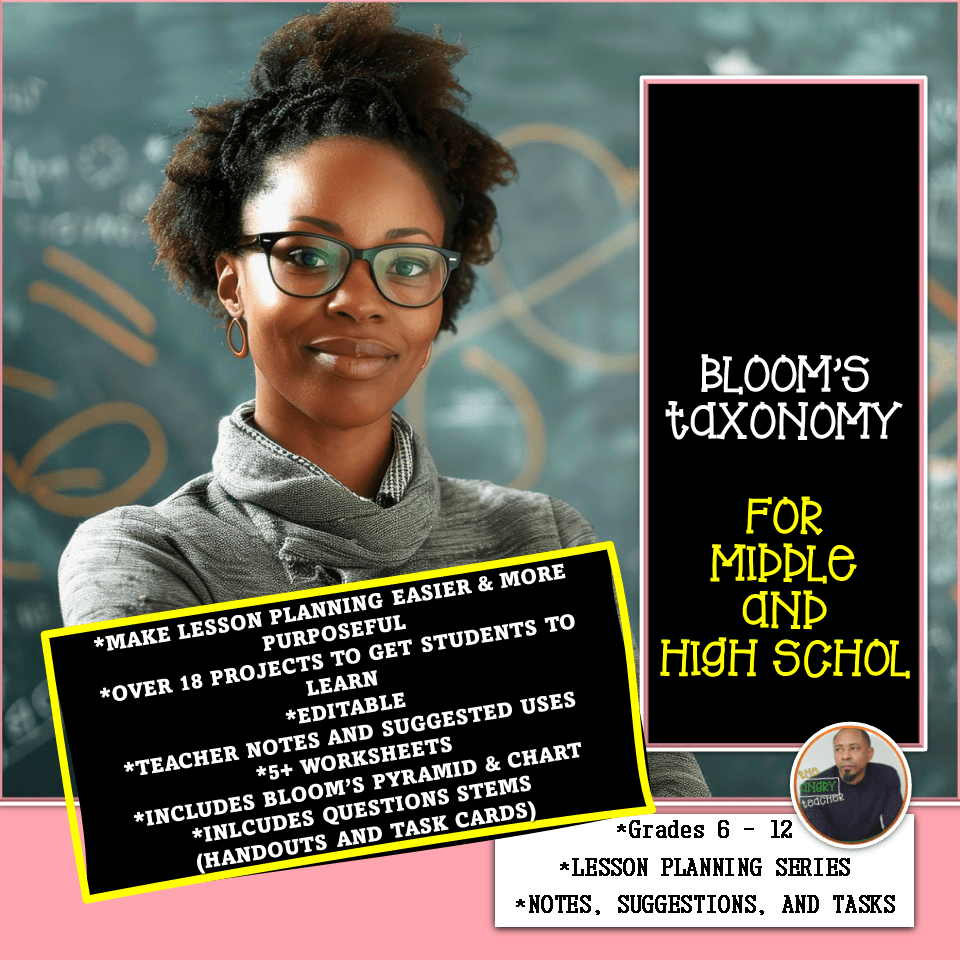




 The Angry Teacher
Leave a comment